Reposted from N.C. Policy Watch
A few months ago, my former client Robert Bacon died in the hospital at Central Prison. Because of COVID-19, he died alone. His loving sister had only a video call with him a few weeks after medical staff stopped Robert’s cancer treatments.
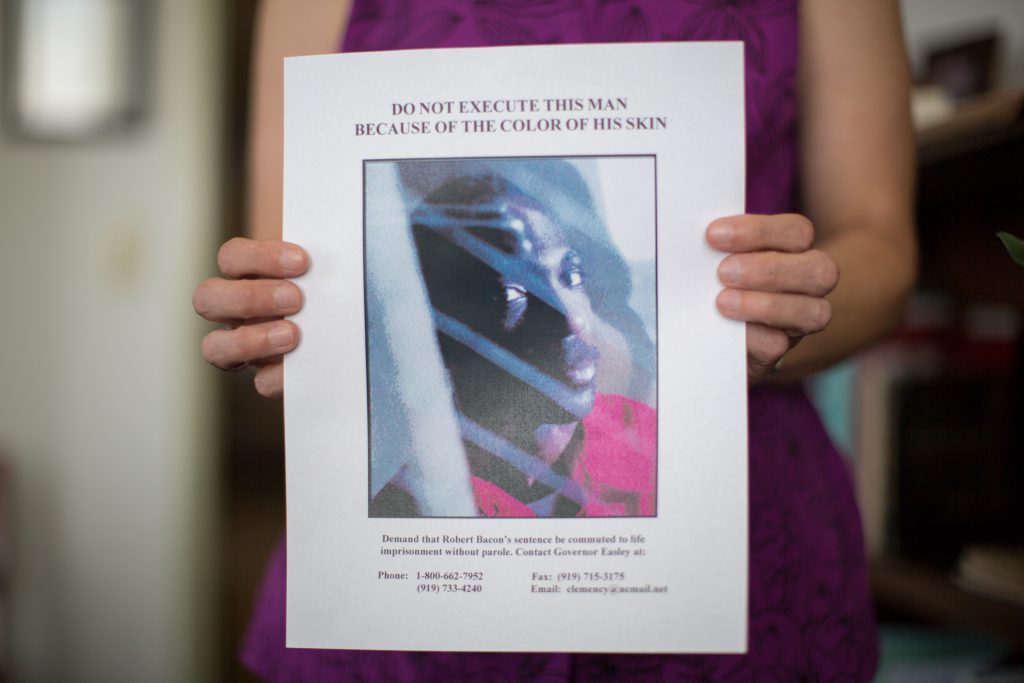
I’ve been thinking about Robert a lot lately, because 20 years ago this week, he was scheduled to be executed. But on Oct. 2, 2001, three days before he was to receive a lethal injection, Gov. Mike Easley issued a rare grant of clemency, allowing Robert to serve out his natural life in prison.
Robert was one of only five people to receive clemency in North Carolina since the modern death penalty was created in 1976. The racism in his case was so great that even a governor who presided over more than two dozen executions could not turn away from it.
Bonnie Clark, Robert’s white girlfriend, co-defendant, and clear mastermind of the murder of her estranged husband, was tried first and got a life sentence. Prosecutors nevertheless demanded the death penalty for Robert, and the all-white jury agreed. Robert was sentenced to death despite the pleas of his family members and the fact that he had never even been arrested before he met Bonnie.
As one of Bonnie’s attorneys explained to me, when I asked about the disparity in sentences:
You know what I think happened? Robert Bacon is a very dark-skinned Black man, very dark-skinned. She was white. The victim was white. To tell you the truth, that’s what I think happened, that’s what I think the jury thought about.”
Years later, I confirmed the truth of this hunch. One of Robert’s jurors admitted that race was explicitly discussed during punishment deliberations. She told me jurors believed “Blacks commit more crime. It’s typical of Blacks to be involved in crime. He shouldn’t have been dating that white woman. He was wrong to do that. And he deserves the death penalty.”
The juror signed an affidavit eight days before Robert’s date with the executioner and, three days later, the Sunday edition of the Charlotte Observer ran a front-page story headlined, “Juror: Race tainted decision on execution.” The ensuing public outcry led the governor to spare Robert’s life.
This juror had been living out of state during Robert’s initial appeals. It was pure serendipity that at the time Robert was facing execution, the juror was back in North Carolina and reached out to me. Absent her honesty and bravery, Robert may well have been executed.
The day I talked to the juror, another attorney in my office, Zephyr Teachout, went to see Robert. I was excited because I knew the juror’s revelation was a game-changer for our clemency campaign. Zephyr came back from the prison, and I asked her about Robert’s reaction.
“Was he happy?” I wanted to know.
“Actually,” she said, “He felt bad. He looked down for a long time and then said he was sad the jury couldn’t see him. They only saw his color.”
Had jurors been able to see Robert, they wouldn’t have sentenced him to death. They might have even seen him as worthy of a second chance. Robert grew up in a military family in Panama and Massachusetts. He had no history of violence. Years after he graduated from high school, his teachers still remembered how he broke up a fight in the school cafeteria and protected teachers from harm. As a young man, he worked in a youth center before coming to North Carolina at age 26. His first job here was selling vacuum cleaners. He met Bonnie after answering an ad for a room for rent.
Robert was always reticent. I think he was deeply ashamed of what he’d done, and he hated that he had disappointed his family, especially his mother and sister, whom he adored.
On death row, he treated his fellow prisoners with kindness. In the weeks before his execution date, Robert emptied his prison account buying coffees for other men on death row. I remember a conversation where he told me about who on death row liked a double-single (two creams, one sugar), a double-double, and so on.
A little over a month before Robert escaped death, another man — Ronnie Frye — was executed. Ronnie deserved clemency just as much as Robert. As a child, his parents gave him away to strangers at a gas station. He was beaten so badly that police used photos of his battered body at child abuse trainings. The jury that sentenced Ronnie to die didn’t know that because his attorney was an alcoholic who, instead of preparing Ronnie’s case, drank at least a pint of rum every night of the trial.
Given the choice, I think Robert would have given his own life to spare Ronnie.
In the past 20 years, Robert sent me Easter and Christmas cards every year. His mother called me several times a year until her death in 2014. Robert and my mother were pen pals as well. I saw Robert a few years ago, after he was first diagnosed with cancer. Despite his dire prognosis, he was relaxed and calm. He seemed to have reached a place of peace with himself.
Even in prison with no chance of release, Robert’s life meant something. Strapping him onto a gurney and killing him would not have made our world better in any way. He inspires me to keep working until no one is in danger of being executed by the state — and to fight against the many other racist death sentences that still stand in North Carolina.
I think of Robert every time I order a triple-triple.