Subscribe to Our Newsletter

This field is for validation purposes and should be left unchanged.
Name(Required)
Email(Required)
Address(Required)
Check all that apply:

  • Skip to main content
  • Skip to footer

NC Coalition for Alternatives to the Death Penalty

Committed to ending the death penalty and creating a new vision of justice

  • Who We Are
    • Mission & History
    • Our Values
    • People Most Proximate
    • Coalition Members
    • Staff, Board, & Advisory Council
    • Our Funders
  • What We Do
  • Why End the Death Penalty?
    • Column 1
      • Racism
      • Innocence
      • Intellectual Disability & Mental Illness
    • Column 2
      • Public Safety
      • High Cost of Death
      • Waning Support
    • Column 3
      • Lethal Injection
      • Antiquated Sentences
      • Unfair Trials
  • Events
  • The Pledge
  • Blog
  • Commutations Campaign
  • Get Involved
  • Donate

Search NC Coalition for Alternatives to the Death Penalty

I’ve seen the horror of executions; Gov. Cooper must act to prevent them from happening again

August 23, 2023 · Meg Eggleston

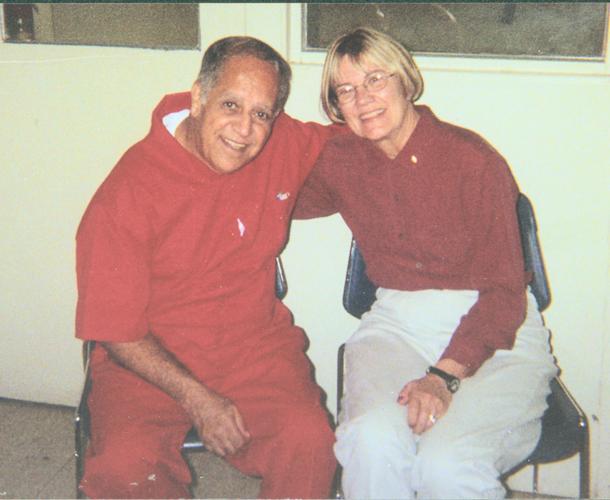
Elias Syriani and Meg Eggleston

Originally published on NC Newsline.

By Meg Eggleston

This month marks the seventeenth anniversary of North Carolina’s last execution. Between 1984 and 2006, North Carolina executed 43 people. For some, it might feel like executions are ancient history in our state. However, the enormous pain they caused is still very much with us. I know because, in 2005, I stood by helplessly as the state of North Carolina killed a man and devastated a family that I cared about deeply.

Elias Syriani was a beautiful soul who did a horrendous thing when he murdered his wife, depriving his four young children of their mother. It’s hard to understand how both those things can be true. But after visiting Elias monthly for five years, I am certain it is so.

In the years that I wrote and visited with Elias, I learned about his childhood in Palestine and Jordan, his career as a professional singer, his troubled arranged marriage filled with cultural conflicts, and his grief over his estrangement from his children. However, right around the time his execution date was set, his children reached out to request a visit with their father. After that, I was lucky enough to become close with his children too.

When that first meeting between Elias and his children occurred, even with all the nervousness, they each felt the love that had been buried for so many years. Forgiveness, though the word was not mentioned at first, was in everyone’s hearts. This was their father, their only living parent, the only person who could tell them stories of their times together before.

The children made a commitment that they would campaign for their father’s life to be spared. I was in Raleigh with them when they visited Gov. Easley to make their own personal pleas to spare the life of this man they were getting to know again as a father. 

Elias’ execution was scheduled on a sunny day in November 2005. His children and I all visited with him, holding out hope that the governor would hear their pleas and grant a last-minute reprieve. That evening, as I prepared to speak to a group that had gathered to protest the death penalty, we got the news that his execution would go forward. 

Gov. Easley had allowed Elias’ children to beg for his life, only to disregard their wishes entirely.

Elias did not want his children to be on the prison grounds while he was killed, so they left while many others held vigil, holding candles in the dark. When the children called me the next day, they were grieving and broken. They had now lost both their parents. 

I have always been against the death penalty. I am against killing in any form. However, this experience showed me even more clearly how senseless and cruel the death penalty is, and how it hurts not just those who are executed, but all the people who knew and loved them. It closes the door to forgiveness and healing. It leaves so many victims in its path.

Today, 137 people remain on death row in North Carolina. While executions are on hold, the death penalty is still on the books and executions could resume. That’s why I’ve joined a growing group of North Carolinians who are asking Gov. Cooper to commute the sentences of all those on death row. He has the power to make sure that no more families are broken by the horror of executions, and I dearly hope he will use it.

Filed Under: Blog, Commutations Campaign, Guest Posts

Meg Eggleston is a retired public school teacher, a mother of three and a grandmother of twelve. She lives in Greensboro.

Footer

Contact

NCCADP Alternate Logo
NCCADP
3326 Durham-Chapel Hill Blvd.
Building D, Suite 201
Durham, NC 27707
noel@nccadp.org
919-404-7409

Follow Us on Instagram

Ed Chapman holds a map that helped save his life. Ed Chapman holds a map that helped save his life.

Nearly 14 years after being sent to death row for a crime he did not commit, this map of Hickory, North Carolina became part of the evidence that proved his innocence. It was developed through years of relentless work alongside his mitigation specialist and law students who refused to give up on his case.

Those 14 years on the row were filled with loss. The men around him became family, and 37 of them were taken, one by one, to the execution chamber. Through it all, Ed kept fighting to come home. He was exonerated in 2008.

A new law in North Carolina  limits the appeals process to just two years. It took Ed 14.

We cannot accept a system that runs out the clock on innocence.

#NCCADP #EndTheDeathPenalty #AbolitionNC #JusticeNC #WrongfulConviction #NoMoreDeathRow
“Me personally, I live death row every day,” Ed Ch “Me personally, I live death row every day,” Ed Chapman shared during our Racist Roots screening at Duke University.

Ed spoke about being wrongfully convicted and losing 14 years of his life to death row after his innocence was deliberately buried by law enforcement in Catawba County.

We're grateful to Duke Partnership for Service (@@duke.dps), Duke Human Rights Center at the Franklin Humanities Institute (@dukehumanrightscenter), and Duke students Rohan, Lameese, and Grace for helping to make this evening possible. Thanks to all who showed up to learn alongside us.

Racist Roots is a project of The Center for Death Penalty Litigation (@centerfordeathpenaltylit).

#NoMoreDeathRow #EndTheDeathPenalty #Duke #NCCADP #RacistRoots
A bad defense can cost a life. Ed Chapman knows th A bad defense can cost a life. Ed Chapman knows that firsthand.

Wrongfully convicted, he survived nearly 14 years on death row before his exoneration in 2008. His original attorneys often showed up smelling of alcohol. They ignored key evidence and lines of inquiry. When Ed tried to have them dismissed from his case, they attempted to keep him from finding new representation.

When a UNC Law student asked how public defenders can best represent their clients, Ed shared this wisdom.

#EndTheDeathPenalty #NoMoreDeathRow #NCCADP #EdChapman #NCDeathPenalty #WrongfulConviction
Follow on Instagram

Stay Connected

  • Facebook
  • Instagram
  • Twitter

Copyright © 2026 · NC Coalition for Alternatives to the Death Penalty · All Rights Reserved · Website by Tomatillo Design