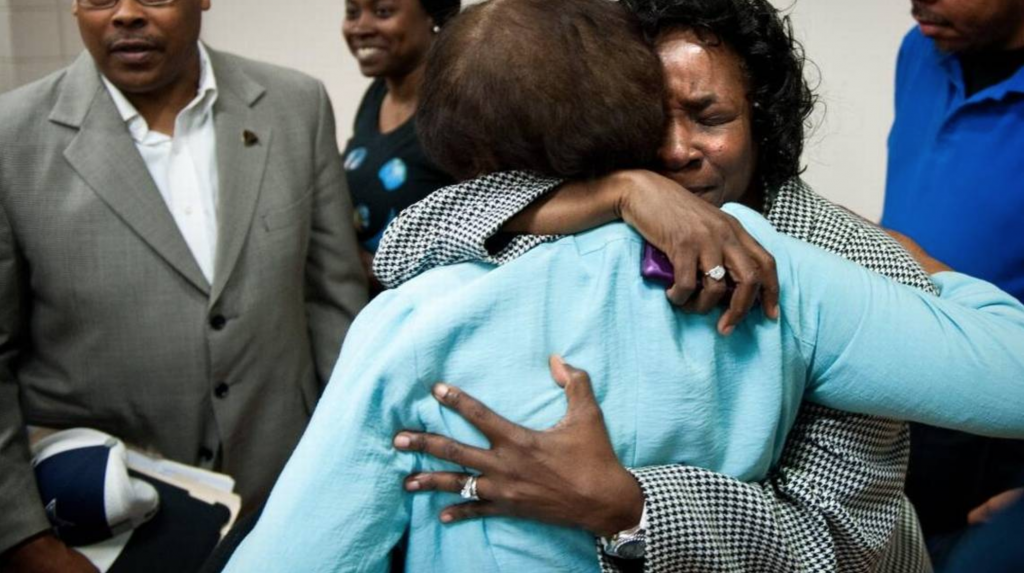
2020 Update: Mr Robinson has been resentenced to life.
By Shirley Burns
I am a mother of four and no stranger to tragedy. One of my sons, Curtis Green, was beaten to death in 2006. His killers dropped his body in a ditch beside a road like he was a piece of garbage.
My youngest son, Marcus Robinson, was sentenced to death in 1994. It truly breaks my heart that Marcus was involved in a crime that took another young man’s life, Erik Tornblom, from his family. He didn’t deserve to die. I know that his parents have suffered this loss with great pain and I am so very sorry.
In 2007, Marcus came within hours of his execution date and time, before it was stopped by the court. They said it was because of problems with the lethal injection process. If the state had killed Marcus, he wouldn’t have lived to see the N.C. Racial Justice Act passed in 2009. This Act revealed evidence that Marcus’s case and others were influenced by racial bias in how prosecutors chose which cases were capital, and how they selected capital juries.
After a two-week hearing in 2012, a judge found that race had been a significant factor in sentencing Marcus to death. The judge resentenced Marcus to life without parole. Our legislature later repealed the Racial Justice Act, which allowed a different judge to overturn Marcus’s resentencing. The repeal disregarded the evidence of racial bias without even looking at it.
Marcus was sent back to death row. This month, the N.C. Supreme Court agreed to hear Marcus’s case to consider whether it was illegal for the legislature to take the RJA away from him after the original judge found there was racial bias in his trial. I am optimistic that the court will not allow the legislature, through its RJA repeal, to sweep the evidence of racial bias under the rug.
The men who killed my son Curtis, who were black, got shockingly lighter sentences. One served 12 to 15 years, a second one got 5 to 6 years and the last one got 2 to 3 years. Seeing Curtis’s case treated this way made me feel like the state didn’t value his life at all.
The state’s approach was completely different when my son Marcus was involved in the murder of Tornblom, a white 17-year-old. The prosecutors pushed for the death penalty for Marcus even though there were many reasons the case should never have been a capital case.
Marcus suffered extreme physical abuse by his father. When he was 3, he was hospitalized with seizures and a traumatic brain injury because of the beatings. I tried to protect Marcus, but my husband beat me too, and threatened to kill me. I left his father when Marcus was 4, but the damage was done. Marcus had brain damage, depression and trouble controlling his behavior.
By the time he was a teenager he ended up in a juvenile detention center for a minor offense. However, he never got the psychiatric care he needed.
Marcus, just turning 18 at the time of Tornblom’s murder, was placed on death row. He was the youngest person there. If Marcus had been only a few months younger, the U.S. Supreme Court would have forbidden a death sentence, because he would have been a juvenile.
Years after the trial was over, prosecutors said in a statement to the legislature that the co-defendant, not Marcus, was the real shooter. Their statement was consistent with what Marcus has always said.
Marcus should not be executed, especially not before the courts hold a fair hearing on the evidence that his death sentence came about in a racially biased manner. One judge has already found that such bias existed. Our Supreme Court, which is bound to fairness, now has a duty to all North Carolina citizens to make sure that this evidence sees the light of day.
Originally published in the Charlotte Observer, March 15, 2018, Mother: Don’t execute my son because of his race.