Subscribe to Our Newsletter

This field is for validation purposes and should be left unchanged.
Name(Required)
Email(Required)
Address(Required)
Check all that apply:

  • Skip to main content
  • Skip to footer

NC Coalition for Alternatives to the Death Penalty

Committed to ending the death penalty and creating a new vision of justice

  • Who We Are
    • Mission & History
    • Our Values
    • People Most Proximate
    • Coalition Members
    • Staff, Board, & Advisory Council
    • Our Funders
  • What We Do
  • Why End the Death Penalty?
    • Column 1
      • Racism
      • Innocence
      • Intellectual Disability & Mental Illness
    • Column 2
      • Public Safety
      • High Cost of Death
      • Waning Support
    • Column 3
      • Lethal Injection
      • Antiquated Sentences
      • Unfair Trials
  • Events
  • The Pledge
  • Blog
  • Commutations Campaign
  • Get Involved
  • Donate

Search NC Coalition for Alternatives to the Death Penalty

Russell Tucker

Learn more: The death penalty is racist

Russell Tucker is an African American man who was sentenced to death in 1996 by an all-white Forsyth County jury. During jury selection, there were five potential African American jurors in the pool, and the prosecutor used discretionary strikes to remove all five. In the 1986 case Batson v. Kentucky, the Supreme Court ruled that removal of jurors on the basis of race violates the Constitution. Russell’s lawyers objected under Batson. The judge found no discrimination.

But the judge did not know the whole story. Years after the trial, as part of the Racial Justice Act, Russell’s lawyers obtained the complete prosecutorial files in his case. They found a copy of a handout from “Top Gun II,” a training course for North Carolina prosecutors. The handout is a cheat sheet designed to help prosecutors violate Batson. During a trial, when the defense objects to the removal of a juror based on Batson, the judge then gives the prosecutor an opportunity to give non-racial reasons for the strike, if they can. By providing a prefabricated list of justifications for strikes, the cheat sheet ensured that prosecutors would always have a reason at the ready, even if their true reason was race.

The handout encourages prosecutors to cite African American jurors’ “rebelliousness,” “air of defiance,” “lack of respect,” “resistance of authority,” and “antagonism,” as reasons they would not make good jurors.

It is clear from Russell’s trial transcript that his prosecutor read from the cheat sheet in court. The prosecutor explained his strike of African American juror Thomas Smalls this way:
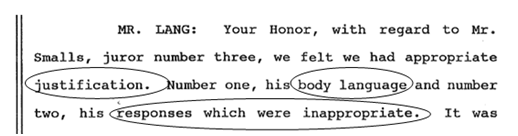
This exact language can be found in the handout.

National experts have condemned this cheat sheet. A group of former prosecutors has called it an example of how “some district attorney offices train their prosecutors to deceive judges” as to their race-based motives for striking jurors of color.

Forsyth County has a longstanding problem with racial discrimination in jury selection. Mr. Tucker is one of four Forsyth defendants on death row who was sentenced to death by all-white juries. A recent Wake Forest University study found that Forsyth prosecutors were three times more likely to strike African Americans than white jurors, the highest strike disparity in the state. The statistical study conducted for the Racial Justice Act concluded that in capital cases from 1990 to 2010, Forsyth prosecutors were more than twice as likely to strike African Americans.

Mr. Tucker’s jury discrimination claim is pending in the North Carolina Supreme Court, which will probably decide the case in 2022.

Read more about Mr. Tucker’s case in this Indy Week story. Or read Emancipate NC’s 2022 law review article about his case.
Filed Under: Racial Bias

Footer

Contact

NCCADP Alternate Logo
NCCADP
3326 Durham-Chapel Hill Blvd.
Building D, Suite 201
Durham, NC 27707
noel@nccadp.org
919-404-7409

Follow Us on Instagram

Tomorrow is the last day to vote early in the prim Tomorrow is the last day to vote early in the primary elections! And as a reminder, election day is March 3. 

With DAs on the ballot across most of the state, voters have a critical opportunity right now to shape how justice happens at the local level. Even though North Carolina preserves the death penalty at the state level, DAs have the authority to decide whether or not they will ever seek death in their districts. 

Stay informed about where your local DA candidates stand on capital punishment and make a plan to vote if you haven't already!

#NoMoreDeathRow #EndTheDeathPenalty #NorthCarolina #NCPrimary
DA races are underway across most of North Carolin DA races are underway across most of North Carolina. At the local level, DAs have tremendous authority to decide how – and if – the death penalty is used.

Stay informed about where DA candidates stand on capital punishment and make a plan to vote!

Early voting runs through February 28 at 3 PM. Primary election day is March 3. 

Visit ncsbe.gov to learn more about voting locations and requirements. If you need help voting, call or text the voter hotline at 888-687-8683.

#NoMoreDeathRow #EndTheDeathPenalty #NCPrimary #NorthCarolina
Florida has executed Melvin Trotter – even amidst Florida has executed Melvin Trotter – even amidst the state's repeated failures to follow its lethal injection protocols. Melvin was the 4th person executed in the US this year and the 2nd person killed by Florida in 2026.

Rest in peace, Melvin. We remember your life and mourn your execution.

#MelvinTrotter #Florida #NoMoreDeathRow #EndTheDeathPenalty
Follow on Instagram

Stay Connected

  • Facebook
  • Instagram
  • Twitter

Copyright © 2026 · NC Coalition for Alternatives to the Death Penalty · All Rights Reserved · Website by Tomatillo Design