Subscribe to Our Newsletter

This field is for validation purposes and should be left unchanged.
Name(Required)
Email(Required)
Address(Required)
Check all that apply:

  • Skip to main content
  • Skip to footer

NC Coalition for Alternatives to the Death Penalty

Committed to ending the death penalty and creating a new vision of justice

  • Who We Are
    • Mission & History
    • Our Values
    • People Most Proximate
    • Coalition Members
    • Staff, Board, & Advisory Council
    • Our Funders
  • What We Do
  • Why End the Death Penalty?
    • Column 1
      • Racism
      • Innocence
      • Intellectual Disability & Mental Illness
    • Column 2
      • Public Safety
      • High Cost of Death
      • Waning Support
    • Column 3
      • Lethal Injection
      • Antiquated Sentences
      • Unfair Trials
  • Events
  • The Pledge
  • Blog
  • Commutations Campaign
  • Get Involved
  • Donate

Search NC Coalition for Alternatives to the Death Penalty

Russell Tucker

Learn more: The death penalty is racist

Russell Tucker is an African American man who was sentenced to death in 1996 by an all-white Forsyth County jury. During jury selection, there were five potential African American jurors in the pool, and the prosecutor used discretionary strikes to remove all five. In the 1986 case Batson v. Kentucky, the Supreme Court ruled that removal of jurors on the basis of race violates the Constitution. Russell’s lawyers objected under Batson. The judge found no discrimination.

But the judge did not know the whole story. Years after the trial, as part of the Racial Justice Act, Russell’s lawyers obtained the complete prosecutorial files in his case. They found a copy of a handout from “Top Gun II,” a training course for North Carolina prosecutors. The handout is a cheat sheet designed to help prosecutors violate Batson. During a trial, when the defense objects to the removal of a juror based on Batson, the judge then gives the prosecutor an opportunity to give non-racial reasons for the strike, if they can. By providing a prefabricated list of justifications for strikes, the cheat sheet ensured that prosecutors would always have a reason at the ready, even if their true reason was race.

The handout encourages prosecutors to cite African American jurors’ “rebelliousness,” “air of defiance,” “lack of respect,” “resistance of authority,” and “antagonism,” as reasons they would not make good jurors.

It is clear from Russell’s trial transcript that his prosecutor read from the cheat sheet in court. The prosecutor explained his strike of African American juror Thomas Smalls this way:
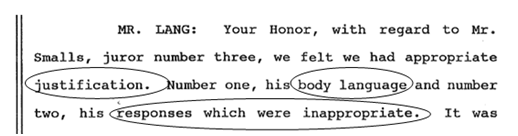
This exact language can be found in the handout.

National experts have condemned this cheat sheet. A group of former prosecutors has called it an example of how “some district attorney offices train their prosecutors to deceive judges” as to their race-based motives for striking jurors of color.

Forsyth County has a longstanding problem with racial discrimination in jury selection. Mr. Tucker is one of four Forsyth defendants on death row who was sentenced to death by all-white juries. A recent Wake Forest University study found that Forsyth prosecutors were three times more likely to strike African Americans than white jurors, the highest strike disparity in the state. The statistical study conducted for the Racial Justice Act concluded that in capital cases from 1990 to 2010, Forsyth prosecutors were more than twice as likely to strike African Americans.

Mr. Tucker’s jury discrimination claim is pending in the North Carolina Supreme Court, which will probably decide the case in 2022.

Read more about Mr. Tucker’s case in this Indy Week story. Or read Emancipate NC’s 2022 law review article about his case.
Filed Under: Racial Bias

Footer

Contact

NCCADP Alternate Logo
NCCADP
3326 Durham-Chapel Hill Blvd.
Building D, Suite 201
Durham, NC 27707
noel@nccadp.org
919-404-7409

Follow Us on Instagram

“Me personally, I live death row every day,” Ed Ch “Me personally, I live death row every day,” Ed Chapman shared during our Racist Roots screening at Duke University.

Ed spoke about being wrongfully convicted and losing 14 years of his life to death row after his innocence was deliberately buried by law enforcement in Catawba County.

We're grateful to Duke Partnership for Service (@@duke.dps), Duke Human Rights Center at the Franklin Humanities Institute (@dukehumanrightscenter), and Duke students Rohan, Lameese, and Grace for helping to make this evening possible. Thanks to all who showed up to learn alongside us.

Racist Roots is a project of The Center for Death Penalty Litigation (@centerfordeathpenaltylit).

#NoMoreDeathRow #EndTheDeathPenalty #Duke #NCCADP #RacistRoots
A bad defense can cost a life. Ed Chapman knows th A bad defense can cost a life. Ed Chapman knows that firsthand.

Wrongfully convicted, he survived nearly 14 years on death row before his exoneration in 2008. His original attorneys often showed up smelling of alcohol. They ignored key evidence and lines of inquiry. When Ed tried to have them dismissed from his case, they attempted to keep him from finding new representation.

When a UNC Law student asked how public defenders can best represent their clients, Ed shared this wisdom.

#EndTheDeathPenalty #NoMoreDeathRow #NCCADP #EdChapman #NCDeathPenalty #WrongfulConviction
Happy Easter from NCCADP to you and your loved one Happy Easter from NCCADP to you and your loved ones! 

In the Christian faith, Easter honors the resurrection of Jesus Christ after his execution by the state. Today, we reflect on liberation from bondage and triumph over death, which is core to the work of ending the death penalty.

If you're looking for a beautiful and thought-provoking read today, consider this piece from 2025 in the Baptist News Global: https://baptistnews.com/article/abolishing-the-death-penalty-in-the-spirit-of-easter-and-passover/
Follow on Instagram

Stay Connected

  • Facebook
  • Instagram
  • Twitter

Copyright © 2026 · NC Coalition for Alternatives to the Death Penalty · All Rights Reserved · Website by Tomatillo Design