A November 2018 case in Buncombe County perfectly illustrated the problems with N.C.’s decades-old death sentences. By today’s laws and standards of justice, most of the people on death row simply shouldn’t be there. Buncombe DA Todd Williams recognized that when he agreed that James Morgan, who has been on death row since 1999, never got the fair trial to which the Constitution entitles him and likely wouldn’t be sentenced to death if he were retried today. Williams remedied the injustice by agreeing that Morgan should be resentenced to life in prison without parole. Here, one of Morgan’s defense attorneys reflects on what this action means for her client and for justice.
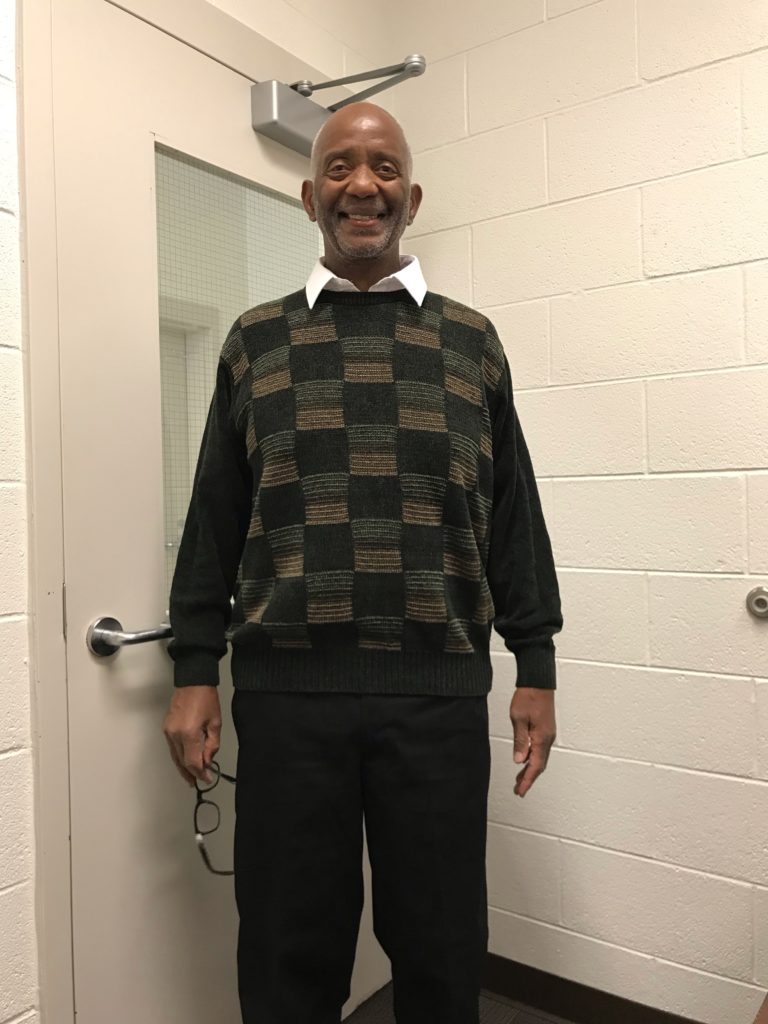
By Elizabeth Hambourger
November 14, 2018
On Friday, Jimmy Morgan was sentenced to life in prison without possibility of parole. And for this he was grateful. The prospect of a lifetime behind bars might not sound like anything to be thankful for, but Jimmy has spent the past 19 years on North Carolina’s death row.
In the years I’ve represented Jimmy, he has often expressed his regret for the crime that resulted in his death sentence. Jimmy was using crack one night in Asheville with Patrina King. The two got into an argument over money, and Jimmy lost his temper and killed Patrina, stabbing her multiple times with a broken beer bottle. With Jimmy’s acceptance of responsibility for this terrible act came knowledge that he would never again live in the free world.
Legally, there was a strong argument that even though Jimmy was guilty, he should never have been sentenced to death. The jury that sentenced him didn’t know that this impulsive crime was in part the product of several traumatic brain injuries, which began in childhood. Jimmy fell out of a moving car at the age of nine. Following the accident, family members noticed a distinct change in his behavior and personality. Later in life, he was hit in the head with a baseball bat and, in a separate incident, a wall-mounted television fell on him from above.
The lawyers who represented Jimmy at trial were given neither the time nor the resources to investigate the impact of Jimmy’s injuries. When a neuropsychologist finally tested Jimmy, years after he’d been sentenced to death, the results showed that he ranks in the bottom 1st or 2nd percentile in several critical areas of brain functioning. The doctor concluded that Jimmy’s brain damage left him unable to make reasoned decisions or control his impulses on the night he killed Patrina King.

It’s apparent when you meet Jimmy that his brain damage has lasted a lifetime. Although he is now 63 years old, Jimmy’s defining feature is his childlike exuberance, expressed with large physical movements and animated facial expressions. In the middle of a conversation, he’ll suddenly break into a tune from The Music Man.
He often speaks and writes in spontaneous rhyme. One of the first times I met Jimmy, he made up an on-the-spot rap about my wristwatch. He plays an energetic air guitar, composes and performs his own hymns for death row worship services, keeps a running tally of the thousands of three-point shots he’s made on the prison basketball court, and likes to entertain people by flipping his cap from his foot to the top of his head.
Jimmy lacks a “filter,” for good and for bad. The dual faces of this impulsiveness are a tragic illustration of the truism that our greatest strengths are often our greatest weaknesses.
Over the many years Jimmy’s case lingered in the courts, other lawyers and I argued that the jury should have been told about Jimmy’s brain damage, and if they’d known, they wouldn’t have given him a death sentence. But multiple courts rejected our argument.
Then last year, the U.S. Supreme Court decided a new case that reaffirmed a criminal defendant’s right to a neuropsychological evaluation. When my co-counsel Mark Kleinschmidt and I brought that case to the attention of Buncombe County District Attorney Todd Williams, he agreed that it entitled Jimmy to a new sentencing hearing. What’s more, Williams realized that if Jimmy were retried now, he would never receive a death sentence. No Buncombe jury has sentenced anyone to death since 2000.
Williams agreed that the proper sentence for Jimmy is life without possibility of parole. This means Jimmy will never get out of prison, but the appeals in his case will finally come to an end. He will move into general population, where he might be able to work a prison job and enjoy a few small privileges – like contact visits that will allow him to finally hold his granddaughter.
At the resentencing hearing Friday, Patrina King’s family spoke to Jimmy and the court. They spoke eloquently of their continuing anger, and of their attempts to forgive even in the face of so much pain.
Jimmy asked me to read his statement of apology:
Thank you for this opportunity to apologize to the King Family. I am very sorry for my actions that took the life of Patrina. I know many people loved her. Every day, I think about it. I do a lot of praying. I understand that I will be spending the rest of my life in prison. I can see the degree of hurt I have caused the King Family and my own family. I love my family and I appreciate their love and support. I’m sorry.
And then, still shackled, he was led out of the Asheville courtroom, not by any means a free man, but free of the death sentence that had been hanging over his head for nearly twenty years.