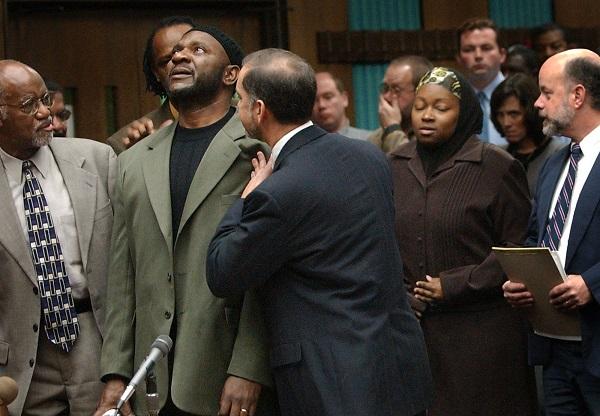
Yesterday, the death penalty trial of Lester Kearney began in Warrenton, North Carolina. Kearney, a Black man, is accused of a terrible crime. An elderly white couple was beaten, robbed, and left tied up in their burning home. Dr. Nancy Alford, a 76-year-old psychologist, died in the fire, while Rev. John Alford, 80, was seriously injured but escaped.
But there’s strong evidence that Kearney is innocent. In opening statements yesterday, his attorneys said phone records show Kearney was miles away at the time of the crime, and all the evidence points to another man, Kevin Munn, as the sole perpetrator. All the items stolen in the crime were found in Munn’s possession. Unlike Kearney, Munn had a prior association with the victims, and there is no evidence of a relationship or even any contact between Kearney and Munn.
Munn initially named Kearney as his accomplice and promised to testify against him in exchange for leniency in his own sentence. But since then, Munn tried to take back that deal, and it is unclear whether he will testify against Kearney. Testimony by witnesses with an incentive to lie is a known contributor to wrongful convictions.
Absent Munn’s questionable accusation, it appears the only evidence against Kearney may be a cross-racial eyewitness identification made by Rev. Alford, the man who survived the attack. But the circumstances of that identification cast serious doubt on its accuracy. From the beginning, Rev. Alford said the perpetrator’s face was covered in camouflage paint, making any identification difficult. And he only identified Kearney after seeing his face on the television news as a suspect in this very case. Such improperly suggestive eyewitness procedures frequently result in mistaken identifications which are the leading factor in wrongful convictions according to the Innocence Project, even when the witness feels absolutely certain their memory is correct.
The case has strong echoes of another North Carolina injustice, the wrongful conviction of Darryl Hunt. In her new book about the Hunt case, Beyond Innocence: the Life Sentence of Darryl Hunt, Phoebe Zerwick tells the story of how, in 1985, Hunt, a Black man, was convicted of a headlines-grabbing Winston-Salem crime, the rape and murder of white newspaper editor Deborah Sykes. Just as in the Kearney case, there was no physical evidence connecting Hunt to the crime. Like Kearney, Hunt was first accused by a witness who then recanted her statement. And like Kearney’s prosecution, Hunt’s rested on highly questionable eyewitness testimony.
In researching her book, Zerwick unearthed chilling pretrial memos written by Hunt’s prosecutor, in which he admitted knowing the case against Hunt was extremely weak. He could have decided to drop the charges. Tragically, he chose to proceed to trial.
Now 30 years later, Warren County District Attorney Mike Waters is making the same choice, not only to prosecute Kearney but to seek the death penalty, despite an absence of evidence that should give any prosecutor grave doubts. We know what that choice did to Darryl Hunt. He spent 20 years in prison before DNA testing proved that the crime was the act of another man, the same man who committed a similar rape in the area a few weeks after Sykes’ death.
With the continued prosecution of Kearney, history is repeating itself. But then, it always has. Zerwick notes that, back in 1985, Hunt’s supporters likened his case to that of another young Black man from Winston-Salem, Clyde Brown, who was executed in 1953, for the rape of a white teenager despite slim evidence that any sexual assault had even taken place. “By the grace of God, justice will flow and Darryl Hunt will not die like Clyde Brown,” wrote Hunt supporter Larry Little during Hunt’s trial.
As Little well knew, Darryl Hunt’s situation could not be properly understood outside the context of Clyde Brown and the many other Black men executed by the State of North Carolina. Between 1910 and 1961, our state executed 362 people, and almost 80 percent of them were Black. African Americans made up 90 percent of those executed for burglary and rape, crimes perceived by whites to be the most racially transgressive. For more about the history of race and the North Carolina death penalty, visit RacistRoots.org.
The prosecutions of Black men like Clyde Brown, Darryl Hunt, and now Lester Kearney show how historical racial disparities continue to leave their mark on the present. What Larry Little said in 1985 continues to be true: “When it comes to justice in America, there is still a double standard.” Black defendants are still far more likely to be wrongfully convicted. Of the twelve innocent men exonerated from death row in North Carolina, eleven are people of color.
As Zerwick recounts in her book, exoneration couldn’t repair the harm done to Darryl Hunt by the prosecutor’s stubborn and cynical decision to fight for a conviction despite the lack of evidence. In 2013, unable to overcome the trauma, Hunt took his own life. Other lives, including those of Henry McCollum and Leon Brown, have also been immeasurably damaged when prosecutors have decided to prosecute cases despite strong evidence of innocence. This harm extends to the families of the innocent.
We can only hope that for Lester Kearney, the trauma ends soon, with a verdict of not guilty. Or, even better, an immediate dismissal of all charges.