Subscribe to Our Newsletter

This field is for validation purposes and should be left unchanged.
Name(Required)
Email(Required)
Address(Required)
Check all that apply:

  • Skip to main content
  • Skip to footer

NC Coalition for Alternatives to the Death Penalty

Committed to ending the death penalty and creating a new vision of justice

  • Who We Are
    • Mission & History
    • Our Values
    • People Most Proximate
    • Coalition Members
    • Staff, Board, & Advisory Council
    • Our Funders
  • What We Do
  • Why End the Death Penalty?
    • Column 1
      • Racism
      • Innocence
      • Intellectual Disability & Mental Illness
    • Column 2
      • Public Safety
      • High Cost of Death
      • Waning Support
    • Column 3
      • Lethal Injection
      • Antiquated Sentences
      • Unfair Trials
  • Events
  • The Pledge
  • Blog
  • Commutations Campaign
  • Get Involved
  • Donate

Search NC Coalition for Alternatives to the Death Penalty

Don’t miss this new project on the Racist Roots of the NC death penalty

October 15, 2020

October 15, 2020

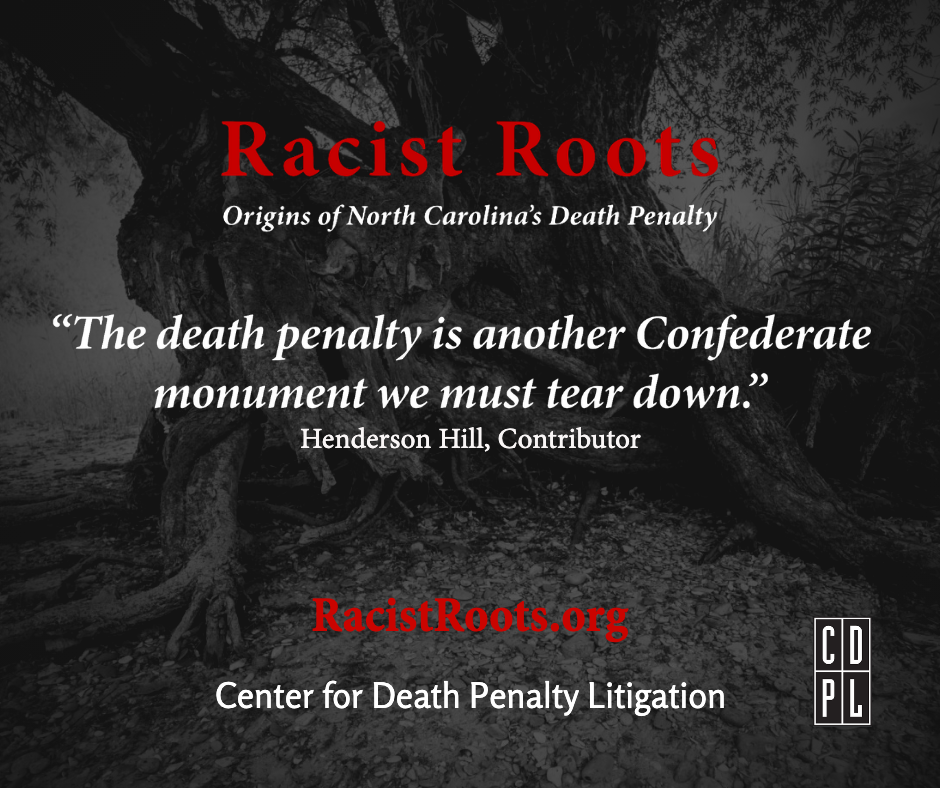
Racist Roots quote

This month, the Center for Death Penalty Litigation launched an ambitious new online project, Racist Roots: Origins of North Carolina’s Death Penalty. 

The project includes essays, poetry, artwork, commentary, and historical documents that place the state’s death penalty in the context of 400 years of history and expose its deep entanglement with slavery, lynching, Jim Crow, and modern systemic racism. The death penalty, the project contends, is another Confederate monument that North Carolina must tear down.

“The death penalty began as a way to enforce a racist social order, and as it evolved through the generations, our state never addressed the original sin that lay at its root,” said CDPL Executive Director Gretchen Engel. “Today, the death penalty is the apex of a racist criminal punishment system that cages hundreds of thousands of people and declares human lives, particularly those of Black people, expendable. The clear message of this project is: Any meaningful conversation about race and criminal justice in North Carolina must include the death penalty.”

Racist Roots shows that in every incarnation, from slavery to post-Civil War Reconstruction, to Jim Crow, and to the modern criminal punishment system, those wielding the death penalty have imposed it disproportionately on Black people; valued the lives of white victims above all others; and excluded citizens of color from power by systematically excluding them from capital juries. So, while the precise influence of racism in the death penalty has changed from era to era, its essential nature has not.

Read Henderson Hill’s essential introduction to the project here, and then head over to RacistRoots.org to explore the rest.
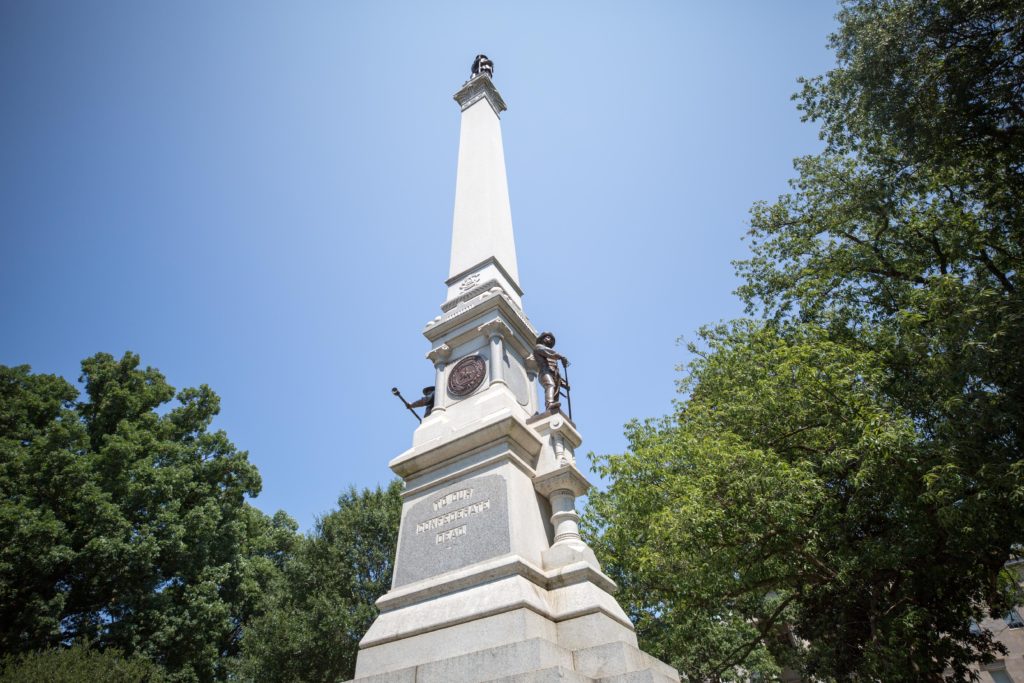

Raleigh Confederate Monument  

The Death Penalty is Another Confederate Monument We Must Tear Down

By Henderson Hill

Right now, our nation is in a moment of reckoning with our criminal punishment system. We are finally seeing clearly what should have been obvious long ago: The system has its knee on the necks of Black people.

In North Carolina, as we begin a long-overdue conversation about the future of police and prisons, we must confront the punishment that sits at the top of that system, condoning all its other cruelties — the death penalty.

When citizens have acclimated to the state strapping a person to a gurney and killing them in front of an audience, it becomes harder to shock them. The death penalty teaches a cruel and inhumane lesson: As long as we brand people criminals, we can kill them.

Meanwhile, there is absolutely no evidence that capital punishment enhances public safety or prevents crime. Instead, it creates more violence and pain, more parentless children and grieving families. I’ve seen this trauma up close as an attorney representing people on death row.

The death penalty’s history is inseparable from our history of slavery, Jim Crow, and mass incarceration.

It is time for us to examine not just the daily cruelties of today’s death penalty, but to see its true nature. And to understand that, we must understand its history.

This report lays bare what too many people, lulled by the myth of a post-racial society, have allowed themselves to forget. The death penalty’s history is inseparable from our history of slavery, Jim Crow, and mass incarceration. Even as the number of executions and death sentences declines, it remains a powerful symbol of white supremacy.

When we open our eyes to the history of capital punishment, the conclusion becomes inescapable. The death penalty is just one more Confederate monument that we must tear down.

READ MORE AT RACISTROOTS.ORG

Filed Under: Latest News

Footer

Contact

NCCADP Alternate Logo
NCCADP
3326 Durham-Chapel Hill Blvd.
Building D, Suite 201
Durham, NC 27707
noel@nccadp.org
919-404-7409

Follow Us on Instagram

Martin Luther King, Jr. was a dedicated death pena Martin Luther King, Jr. was a dedicated death penalty abolitionist. This MLK Day, we reflect on the connection between Dr. King's legacy of nonviolence and the movement to abolish the death penalty.

In 1952, at the young age of 16, Alabama high school student Jeremiah Reeves was accused of sexually assaulting a white woman. In a rushed trial, an all-white jury sentenced him to die. His defense argued that law enforcement had coerced his confession by strapping him to an electric chair and threatening to flip the switch immediately unless he declared his guilt. 

Reeves spent 6 years on death row as his case moved through the appeals process. Dr. King became a strong advocate for Reeves, but the state still put him to death. In 1958, just 9 days after Reeves' killing, Dr. King led a march, the Prayer Pilgrimage, to the steps of the Alabama capitol. In front of a crowd of more than 2,000 people, Dr. King boldly proclaimed the injustices of the death penalty: "It is the severity and inequality of the penalty that constitutes the injustice."

Reeves' execution was a flashpoint for civil rights advocates, one of a long series of injustices that fueled the Montgomery bus boycott and the Civil Rights Movement more broadly.

Throughout his life, Dr. King repeatedly spoke out against the death penalty, which he saw as racist, brutal, antiquated, and fundamentally in opposition to his theory of nonviolence. 

Read more about how we can honor Dr. King's legacy by ending the death penalty on our website: nccadp.org/mlk-day-2026

#NoMoreDeathRow #MLKDay #MartinLutherKingJr #EndTheDeathPenalty
Ready to get mobilized? Join us Tuesday, January 2 Ready to get mobilized? Join us Tuesday, January 27 for our first Death Penalty 101 session of the year! 

Learn about the state of capital punishment in North Carolina, including ways you can get involved in the movement to end state killing. If you're ready to plug in, this is the place to start.

When: Tuesday, January 27 from 5:30-6:30 PM
Where: Zoom 

Register at bit.ly/NCCADPJan2026 or at the link in our bio.

#NoMoreDeathRow #EndTheDeathPenalty #NCCADP #DeathPenalty101
One year ago today, Governor Cooper, on his final One year ago today, Governor Cooper, on his final day in office, announced commutations for 15 men on death row. This news came at the close of our multi-year Commutations Campaign – a testament to the power of this community's organizing and advocacy.

A year later, we continue to rejoice for these 15 lives spared:

Hasson Bacote
Isiah Barden
Nathan Bowie
Rayford Burke
Elrico Fowler
Cerron Hooks
Guy LeGrande
James Little
Robbie Locklear
Lawrence Peterson
William Robinson
Christopher Roseboro
Darrell Strickland
Timothy White
Vincent Wooten

Victories like these remind us what's possible when people resist and dare to imagine something better. 

Even after these commutations, North Carolina continues to have the 5th largest death row in the nation. Here at NCCADP, we will not stop working until the racist, error-prone, and inhumane death penalty is no longer a threat in North Carolina.

If you believe in a future without the death penalty, one great way to show your support is with your dollars. Consider making a tax-deductible gift to NCCADP at nccadp.org/donate or donating by mail at 3326 Durham-Chapel Hill Blvd, Building D, Suite 201, Durham, NC 27707.
Follow on Instagram

Stay Connected

  • Facebook
  • Instagram
  • Twitter

Copyright © 2026 · NC Coalition for Alternatives to the Death Penalty · All Rights Reserved · Website by Tomatillo Design