Henry McCollum and Leon Brown were recently awarded more than $75 million for the law enforcement misconduct that led to their wrongful convictions in 1983. This historic settlement underscores what a massive injustice was done to these two men, who were sent to death row as teenagers and imprisoned for three decades, all for a crime they had nothing to do with. Here, McCollum’s former attorney, Vernetta Alston, remembers the day of their exoneration. Now a state legislator, Alston recently sponsored a bill to abolish the North Carolina death penalty. Originally posted on NC Policy Watch.
By Vernetta Alston
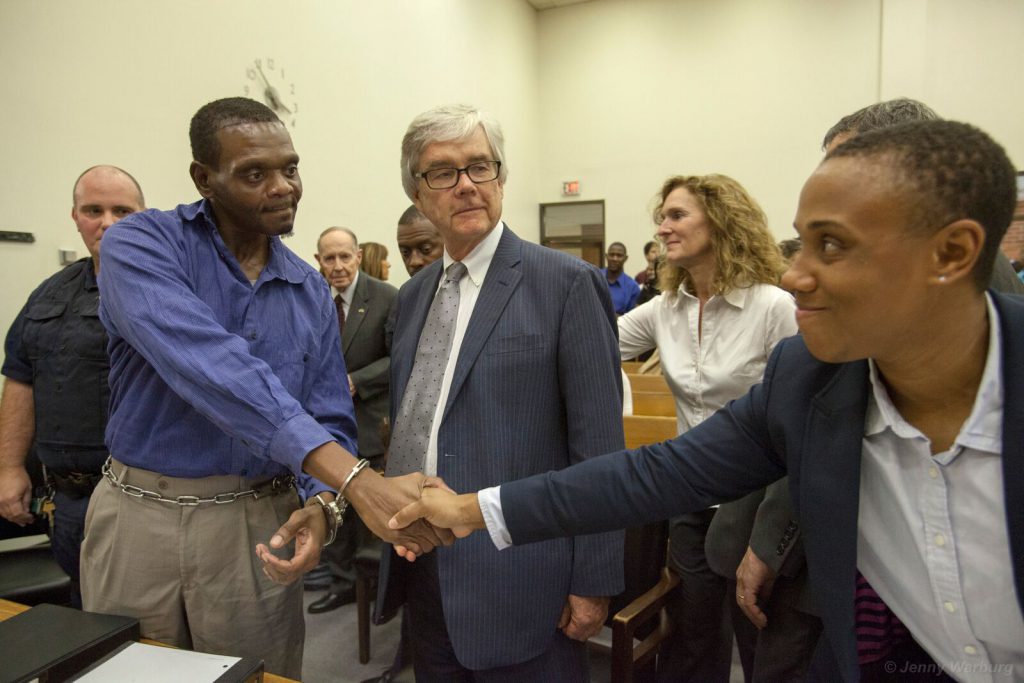
In September 2014, I was sitting with Henry McCollum at the moment a judge ordered his release from death row for a crime he did not commit. Many folks in the courtroom clapped in celebration. Others embraced out of relief. It had been 30 years since Henry and his brother Leon Brown – two innocent and intellectually disabled children – had been convicted and sentenced to death in Robeson County, North Carolina. A case that had captured the country’s attention had come to an end for the two men, who had unflinchingly claimed their innocence for all those years.
The press, lawyers, and advocates rushed to announce the court’s decision. The courthouse buzzed as they explained the 30-years of injustice – undisclosed evidence, new DNA results, the rush to judgment that failed to give closure to the family of the victim, the wrongful incarceration – endured by Henry and his little brother, Leon.
But Henry, the innocent man at the center of it all, remained solemn. After the judge ordered his release, he was led, still shackled, to a small, dim holding area of the same courthouse that took his freedom to begin with. I knelt near him for a few minutes. He was silent and didn’t make eye contact. He was overwhelmed.
Considering all Henry had been through – the manipulation by law enforcement that led to his false confession, being labeled the “worst of the worst” by United States Supreme Court Justice Antonin Scalia, the severe depression he experienced in prison, suicide attempts that resulted from the unimaginable toll of watching friends be executed, and the 30 years of innocence claims that were effectively ignored until that day – he had every right to be overwhelmed.
Henry and Leon’s case is reason enough to repeal the death penalty in North Carolina.
We have a death penalty system that let the false, unrecorded, and coerced confession of a disabled teenager serve as the basis of a death sentence. Henry’s case also showed us the lengths prosecutors will go to in pursuit of the death penalty, like withholding evidence including the recantation of the witness who originally led police to Henry, and neglecting to do fingerprint testing that would have revealed the identity of the real perpetrator.
Thirty years of strong legal claims and personal protests were not enough to get Henry off death row. He was exonerated by DNA evidence. Few criminal cases have DNA evidence at all. Henry was lucky and luck cannot be a safety valve to protect innocent people from an ineffective system.
But it isn’t just the innocent who suffer under a broken death penalty system. There are countless people on North Carolina’s death row who live under the weight of their actions and the sorrowful reality that their poverty, substance abuse disorders, mental illnesses, personal trauma histories, or race made them easy targets for death penalty prosecution in a system that, until recently, lacked important checks on investigative tactics, state discretion, or the defendant’s right to due process.
More than 90% of our death row was convicted in the 1990s, before confessions were required to be recorded. In about 80% of cases, defendant’s did not have the right to see their files before trial. Nationwide, at least 20% of death row inmates are mentally ill and many suffered from substance use disorders.
In light of this and the reality that Henry’s is not the only death penalty case in North Carolina with faulty evidence, police coercion, or prosecutorial misconduct, we should stop subjecting people to the ultimate punishment.
Whether guilty or innocent, killing people does not bring any more justice into the world – only more sorrow and violence.
In the fall of 2014 at the Robeson County Courthouse, I stared at a free man consumed by three decades of despair, injustice, and oppression caused by the death penalty and its actors. It was a historic day and one of the saddest days of my life. We must repeal the death penalty.
Vernetta Alston was elected to the North Carolina House of Representatives in 2020. She worked as a capital defense attorney at the Center for Death Penalty Litigation for five years. She previously served on the Durham City Council.