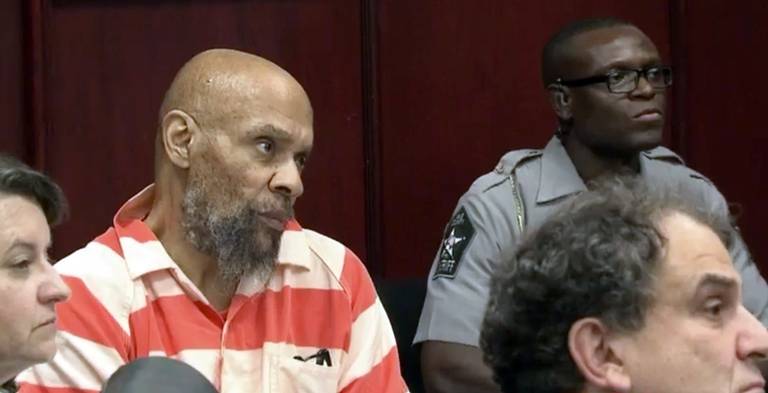
This week, James Blackmon was freed after 35 years in prison for a murder he didn’t commit. He was convicted in Wake County, based on his own false confession — which police dragged out of him after hours of coercive interrogation. Here, CDPL attorney Elizabeth Hambourger explains how false confessions happen.
Most of us think, “I would never confess to a crime I didn’t commit.” But the sad reality is, people do it all the time.
More than a quarter of DNA exonerations involve a false confession. North Carolina’s longest serving death row exonerees, Henry McCollum and Leon Brown, were sentenced to death and spent a combined 60 years in prison because police interrogators manipulated them into taking responsibility for a terrible crime they had nothing to do with. And how many more Henrys and Leons are sitting in North Carolina’s prisons?
Many American law enforcement officers are trained to conduct interrogations in ways that recklessly encourage false confessions. Using the popular Reid Technique, interrogators first examine a suspect’s body language for clues that supposedly indicate guilt. In truth, these non-verbal cues often indicate simple nervousness. But once interrogators decide a suspect is guilty, their only goal becomes to obtain an admissible confession. They might weaken a suspect’s defenses by depriving them of sleep and food. Or lie to a suspect, confusing them with invented but convincing evidence of their own guilt. Or they might minimize the seriousness of the suspect’s supposed actions, offering morally acceptable motives, such as accident or self-defense, which the suspect might endorse in hopes of ending the interrogation.
You’ve probably seen all this on TV police dramas, but it’s ruining the lives of real-life innocent people. Today, a three-judge panel in Wake County exonerated James Blackmon, a man with severe mental illness who was manipulated into confessing to a 1979 murder at St. Augustine’s College. The flimsiest of evidence brought police to Blackmon’s bedside at Dorothea Dix, a mental hospital where Blackmon was confined. Four years after the murder of St. Aug’s student Helena Payton, long after the case had gone cold, police received a tip that an anonymous patient at Dix had confessed to a similar-sounding crime. Though there was no patient at Dix with the name the informant gave, police somehow ended up interrogating Blackmon.
Blackmon’s mental illness was immediately apparent. He compared himself to Dracula, claimed to have telepathic powers and the ability to cause natural disasters, and reported seeing UFOs. Officers noted that he wore a cape like Superman. In addition to suffering from schizoaffective disorder, a major psychotic illness, Blackmon’s IQ has tested as low as 69. Studies have found that those with mental and cognitive disabilities are more likely to give false confessions.
Despite his vulnerabilities and the lack of any evidence linking him to the crime, police interrogated Blackmon over and over. In fact, according to false confession expert Allison Redlich, they used Blackmon’s mental illness to manipulate him. Eventually, Blackmon agreed with the officers that “the bad James Blackmon” must have killed Payton while the “good James Blackmon” was somewhere else. But, tellingly, Blackmon did not even know basic facts of the crime, including how Payton was killed.
Blackmon’s “confession” was the only evidence against him. Detectives never found any physical evidence or eyewitnesses linking him to Helena Payton or the crime scene. In fact, there is physical evidence pointing to another suspect, and it now seems likely that Blackmon was in New York when Payton was killed. Yet, facing the possibility of a death sentence, Blackmon pled guilty and received a life sentence, even while still proclaiming his innocence.
Despite compelling evidence that the confession was false, Wake District Attorney Lorrin Freeman fought Blackmon’s exoneration. She could have agreed to his release, as the prosecutor did in Henry and Leon’s case. Instead, she said the burden was on him to prove his innocence, an extremely high bar that stops many innocent people from ever being released from prison. Now that Blackmon has been ruled innocent by the three-judge panel, his case casts further doubt on the reliability of confessions, the techniques law enforcement officers use to obtain them, and prosecutors’ decisions to rely on them to secure convictions and induce pleas. Today will be a hollow victory for a man who has spent 35 unjustified years in prison — unless prosecutors and police use this as an occasion to reevaluate the widespread practices that lead to wrongful convictions.