Subscribe to Our Newsletter

This field is for validation purposes and should be left unchanged.
Name(Required)
Email(Required)
Address(Required)
Check all that apply:

  • Skip to main content
  • Skip to footer

NC Coalition for Alternatives to the Death Penalty

Committed to ending the death penalty and creating a new vision of justice

  • Who We Are
    • Mission & History
    • Our Values
    • People Most Proximate
    • Coalition Members
    • Staff, Board, & Advisory Council
    • Our Funders
  • What We Do
    • Commutations Campaign
  • Why End the Death Penalty?
    • Column 1
      • Racism
      • Innocence
      • Intellectual Disability & Mental Illness
    • Column 2
      • Public Safety
      • High Cost of Death
      • Waning Support
    • Column 3
      • Lethal Injection
      • Antiquated Sentences
      • Unfair Trials
  • Events
  • 20 Years With No Executions
  • Blog
  • The Pledge
  • Get Involved
  • Donate

Search NC Coalition for Alternatives to the Death Penalty

Newly discovered innocence cases show how old problems still haunt the N.C. death penalty

March 10, 2021

This piece by Kristin Collins of the Center for Death Penalty Litigation was published on March 10, 2021 by N.C. Policy Watch.

Last month, two new men were added to the list of innocent people who’ve been sentenced to death in North Carolina. 

Anthony Carey was sentenced to execution for a murder he took no part in, based entirely on the testimony of a 16-year-old who had made a deal with the police. The teen said that while he robbed and murdered a gas station attendant, Carey was a passenger in a getaway car parked blocks away. In exchange for that testimony, the prosecutor allowed the teen to plead guilty to second-degree murder while Carey went to death row.

John Thomas Alford was sent to death row for a shooting in an auto parts store, even though four people testified he’d been playing basketball with them at the time of the crime — and even the co-defendant who carried out the murder said Alford wasn’t involved.

The district attorney withheld that last piece of evidence, saying he didn’t want to “confuse the jury” by showing them evidence of Alford’s innocence. Instead, he focused on a suspect lineup where four witnesses picked Alford. However, police polluted the lineup by showing witnesses Alford’s photo beforehand, a tactic that all but assured they would select him.

Both men were tried in Charlotte in the 1970s and had their convictions overturned after spending about a year on death row. Their exonerations had been lost to time until the national Death Penalty Information Center discovered them in the course of researching a new report. Nationwide, DPIC uncovered eleven new death row exonerations, bringing the total to 185 — one for every eight executions that have been carried out in the United States. 

With the addition of these cases, North Carolina has sentenced 12 innocent men to death since 1973. They spent a total of 157 years in prison for crimes they didn’t commit. 
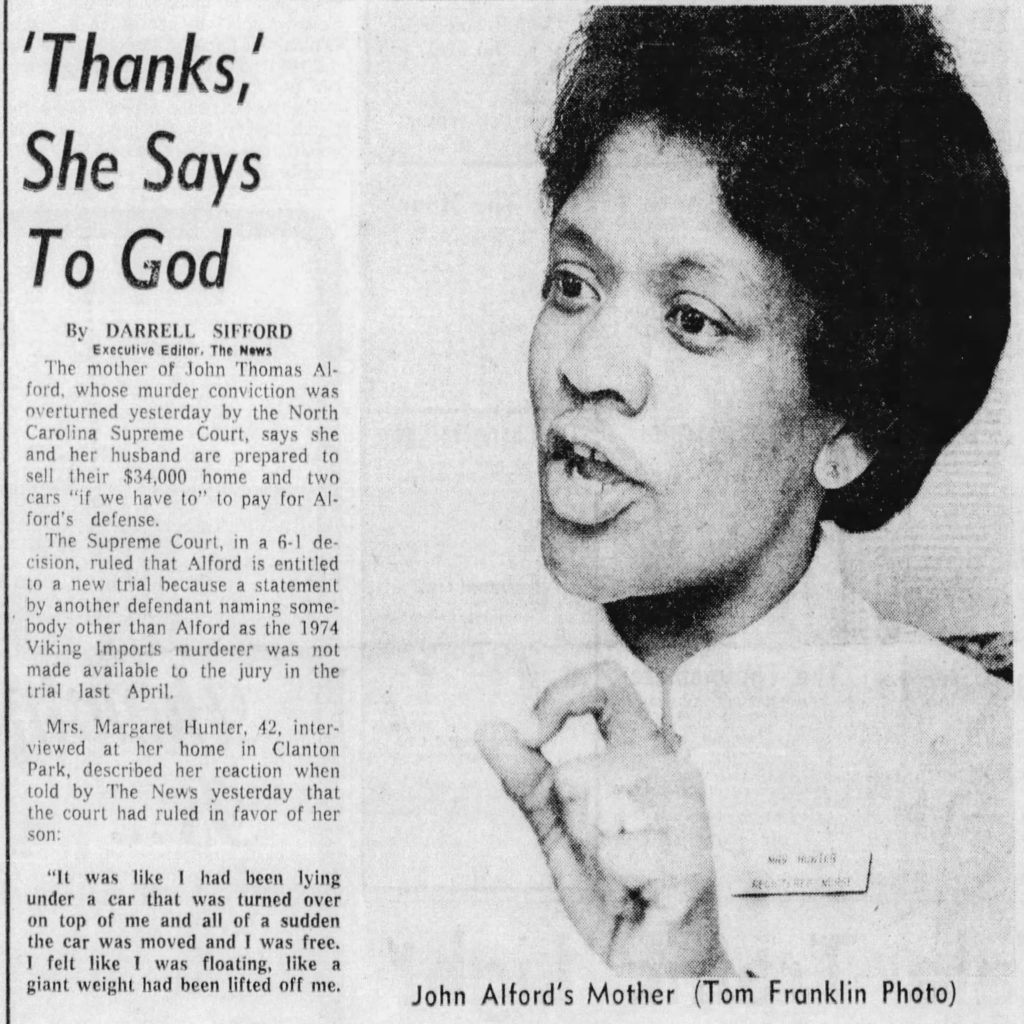
John Thomas Alford’s mother was interviewed for the March 3, 1976 edition of the Charlotte News, after he won a new trial. After being sentenced to death at his first trial, Alford was acquitted at his second trial.

Both Carey and Alford are Black men who were accused of killing white people — once again bearing out the truth that Black men are more likely to be wrongly convicted , especially in cases with white victims. Of North Carolina’s twelve exonerees, ten are Black, one is Latino, and only one is white. Seven of the cases involved white victims.

Though these exonerations happened close to 50 years ago, many of the systemic flaws they exposed play a role in current death row cases. 

For instance, several people on North Carolina’s death row were implicated by unreliable witnesses or co-defendants who were seeking deals in their own cases. Others were convicted with the help of tainted eyewitness identifications, which are a frequent cause of wrongful convictions. And under North Carolina’s felony murder rule, people can still be sentenced to death for killings they did not personally carry out or for which they were not even present. 

News stories from the time also noted that Alford had an all-white jury, which discounted the testimony of four Black alibi witnesses. “To hear those four tell it, all they did was play basketball,” one juror told the Charlotte News. “They didn’t work. How could you believe somebody who doesn’t work?”

The exclusion of Black jurors remains a pressing problem across North Carolina. Recently, the N.C. Supreme Court ruled that almost everyone on death row should be allowed to present evidence of systemic discrimination in jury selection under the Racial Justice Act.

These cases are also a reminder that every wrongful conviction is like a bomb going off, affecting not just the person who receives the death sentence but their family and community.

Carey’s brother Albert was sentenced to death alongside him, as the alleged driver of the getaway car, and he was never exonerated. Instead, he was resentenced to life and spent three decades in prison because of a 16-year-old’s allegation.

According to interviews in the Charlotte News, Alford’s mother took a second mortgage on her home to pay for his defense. His stepfather had to work a second job at night to pay it off. And hundreds of community members contributed to his legal defense fund for a second trial. His mother said she asked herself during the ordeal, “Why is this happening to us? Are we being punished? What’s the use of trying to live a good, decent life?”

A system as error-prone as the death penalty breeds distrust that can last for generations and creates harm that can never be healed, no matter how many people we exonerate.

Filed Under: Innocence, Latest News, Uncategorized

Footer

Contact

NCCADP Alternate Logo
NCCADP
3326 Durham-Chapel Hill Blvd.
Building D, Suite 201
Durham, NC 27707
noel@nccadp.org
919-404-7409

Follow Us on Instagram

You're invited! We hope you'll join us on June 23 You're invited! We hope you'll join us on June 23 for a webinar featuring some of the top experts who have helped shape North Carolina's death penalty landscape over the past 2 decades.

For nearly 20 years, North Carolina has paused executions while courts, impacted families, and communities across the state have continued grappling with the realities of the death penalty system. What have these two decades revealed?

Featured speakers:
• Henderson Hill, Co-Director of RedressNC, civil rights and capital defense attorney
• Rep. Vernetta Alston, North Carolina Representative and former capital defense attorney
•  Alfred Rivera, North Carolina death row exoneree and activist
•  Dr. Seth Kotch, Associate Professor of American Studies at UNC-Chapel Hill, author of Lethal State: A History of the Death Penalty in North Carolina

Moderated by NCCADP Executive Director Noel Nickle.

💻 20 Years With No Executions: What Have We Learned? (Webinar)
📆 Tuesday, June 23, 12–1:15 PM
📍 Zoom
🔗 Register at bit.ly/nccadpwebinar or at the link in our bio

#NoMoreDeathRow #EndTheDeathPenalty #NorthCarolina #20YearsWithoutExecutions #20thAnniversary #FYP
We're delighted to share that Melissa Boughton (@m We're delighted to share that Melissa Boughton (@melbough) has stepped into a new role as Board Co-Chair of NCCADP, serving alongside Erica Washington (@erica_webber_).

Melissa brings a wealth of experience in communications and advocacy to this role. She currently serves as Communications Director at Southern Coalition for Social Justice and previously led communications at the Wilson Center for Science and Justice at Duke Law School. Before that, she spent more than a decade as a journalist covering courts, criminal legal issues, and some of the most consequential justice stories of our time.

Melissa has long been a valued leader within NCCADP. We're excited for this next chapter of her leadership and grateful for all she contributes to our movement.

We're equally thankful for Erica Washington's longstanding service as board Co-Chair!

As we welcome Melissa into this role, we also extend our deepest thanks to Jennifer Marsh for her years of service as Board Co-Chair. Jennifer's leadership has helped strengthen NCCADP and our movement in countless ways. We are grateful that she will continue serving on the board as Secretary through the end of the year.

Please join us in congratulating Melissa and thanking Jennifer for her leadership!

Photo 1: Melissa Boughton
Photo 2: Erica Washington
Photo 3: Jennifer Marsh

Learn more about our board members at https://nccadp.org/leadership/
📢 NEW COALITION PARTNERS 📢 Please join us in warm 📢 NEW COALITION PARTNERS 📢

Please join us in warmly welcoming NC NAACP (@ncnaacp1) and Deep Time (@deeptimeavl) to NCCADP!

During our spring coalition call, members unanimously voted both new partners into our movement. We're delighted to share that our coalition has now grown to 27 organizations.

The North Carolina State Conference of the NAACP works to “achieve equity, political rights, and social inclusion by advancing policies and practices that expand human and civil rights, eliminate discrimination, and accelerate the well-being, education, and economic security of Black people and all persons of color.” Their longstanding leadership in civil rights advocacy strengthens our shared work to challenge systems of injustice and build a more equitable future.

Deep Time is an Asheville-based coffee roaster and community space “celebrating, employing, and creating spiritual community with people impacted by incarceration.” Their work reflects the transformative possibilities of community-rooted reentry support.

Give these amazing organizations a follow if you haven't already!
Follow on Instagram

Stay Connected

  • Facebook
  • Instagram
  • Twitter

Copyright © 2026 · NC Coalition for Alternatives to the Death Penalty · All Rights Reserved · Website by Tomatillo Design