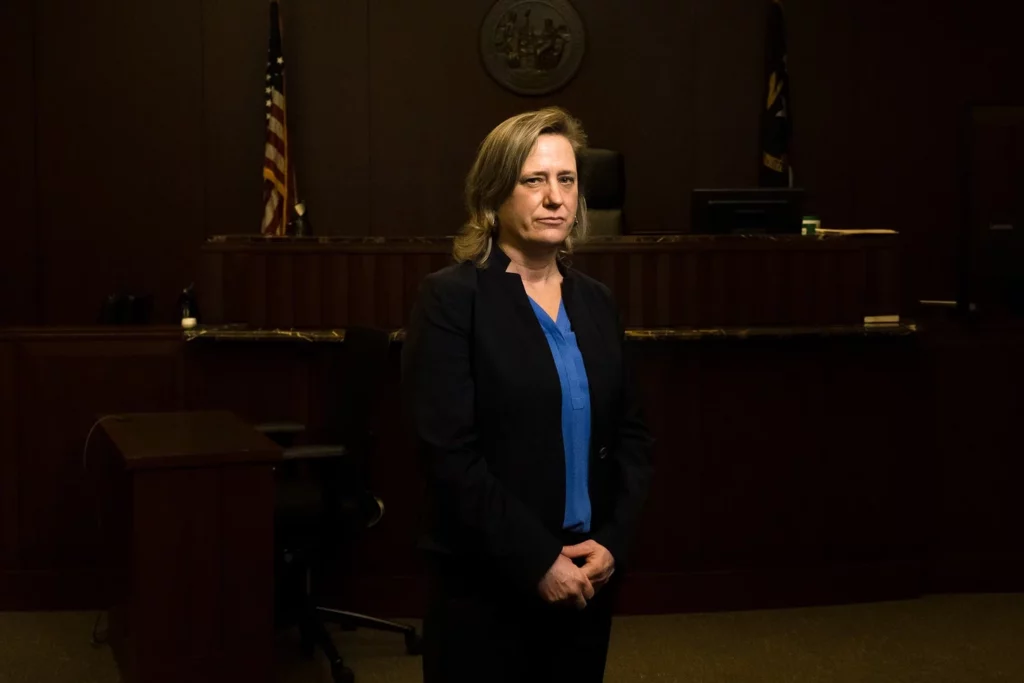
A new story by Jeffrey Billman in The Assembly has done a huge public service: It’s given us a much fuller picture of one of North Carolina’s most powerful district attorneys — and one of our state’s most prominent advocates of the death penalty, Lorrin Freeman in Wake County. What we saw was deeply disturbing.
The article was full of quotes that it’s almost hard to believe Freeman, a person who is tasked with serving the public and doing justice, was willing to say aloud. But she did, so let’s talk about some key pieces of the article.
First, Billman made clear that Freeman’s frequent use of the death penalty is part of a pattern of regressive policies and an absolute disregard for the harm she creates in the lives of vulnerable people.
Between 2015 and 2020, she sought the death penalty more than any district attorney in the state. She opposed a bill prohibiting life-without-parole sentences for juveniles. She threw the book at a man who sold a pawn shop five stolen video games for $12; the Court of Appeals called his nine-and-a-half-year sentence “grossly disproportionate.” She unapologetically prosecutes marijuana possession.
Next, it was clear that Freeman is prosecuting people for very serious crimes without making sure they are actually guilty.
Ossiwald Moore, a Garner 16-year-old arrested for murder in March 2019 and jailed on a $5 million bond, finally went on trial in December 2021. After Moore spent two years and nine months behind bars, a Wake County jury acquitted him within three hours. Assistant public defender Molly O’Neil said Moore’s case was riddled with errors and should have been dismissed long before it saw a courtroom…
In 2021, Wake County prosecutors lost five of 12 murder trials, according to a list provided by the district attorney’s office. Two of their seven wins ended with manslaughter convictions.
Even when she knows the person is innocent, she doesn’t seem to care. Take the case of a Black man with severe mental illness who was wrongly imprisoned for 36 years.
In 2018, Freeman opposed James Blackmon’s release from prison after the North Carolina Innocence Commission determined that two Raleigh detectives coerced a false murder confession from him 35 years earlier. Freeman admits she wouldn’t have prosecuted Blackmon—a Black man who suffered from mental illness—without physical evidence linking him to the crime (there was none).
But she told the three-judge panel deciding Blackmon’s fate that decades ago, courts ruled his confession admissible, so absent DNA that proves his innocence, he should remain behind bars.
It’s appalling that Freeman seems to use her power so carelessly, considering that she has the power to seek the death penalty. And while the article mentions that she attended implicit bias training, it did not mention that her office has a record of denying Black citizens the right to serve on juries. Studies show Wake has a widespread problem of excluding Black jurors, but Freeman’s office has taken few concrete steps to address it.
That leads us to what was perhaps the most disturbing aspect of the article: Freeman’s casual dismissal of racism in the criminal punishment system — and her utter failure to take responsibility for correcting it. She apparently believes in accountability for the people she prosecutes, but not for her own office and its role in perpetuating racism.
According to Freeman, racism is a huge problem in American society. She says there are racial disparities in virtually every critical system. Yet, she refuses to admit any racial disparity in her own office’s handling of cases, even though the people she prosecutes are overwhelmingly people of color. All but one of the people she’s tried capitally has been a Black man.
Until we get serious about addressing the disparities or the inequities in health, substance abuse treatment, mental health treatment, economic opportunity, and educational opportunity, you’re going to continue to have this disparate representation in the justice system, and it’s not something the justice system can fix.
Lorrin freeman
This statement amounts to a callous shrugging of the shoulders in the face of racism that is destroying people’s lives. She also seems to practice willful blindness. According to the article, Freeman was presented with evidence that, after a rash of traffic stops in a Raleigh nightclub district, 81 percent of one officer’s charges were against people of color. For another officer, it was 74 percent. Freeman said that “did not substantiate a pattern of profiling.”
Freeman’s final statement was perhaps the most insulting to people whose lives are being destroyed by a racist system.
I mean, people want the system to move. I understand that, especially if you’re somebody who feels like the system works against you. But in terms of redefining the criminal justice system, it really has to—to some extent—be an incremental process, because you have this tension. Everybody needs to be in a position where they can feel safe and feel like the law can be upheld.
Lorrin freeman
Her comments caused us to go back to Dr. Martin Luther King’s words in his Letter from Birmingham Jail:
For years now I have heard the word “wait.” It rings in the ear of every Negro with a piercing familiarity. This “wait” has almost always meant “never.” It has been a tranquilizing thalidomide, relieving the emotional stress for a moment, only to give birth to an ill-formed infant of frustration. We must come to see with the distinguished jurist of yesterday that “justice too long delayed is justice denied.”
Tell an innocent person who’s sitting in prison that change must be incremental. Tell that to a person who’s serving decades on a marijuana charge while, for a myriad of reasons, his white counterpart was never arrested. Tell that to the Black man with severe mental illness who can barely understand the legal process, let alone why Freeman is prosecuting him for the death penalty.
It seems Lorrin Freeman has forgotten she’s talking about real people’s lives.
To read the full story in The Assembly, either register for a free article or support this important journalism with a subscription.