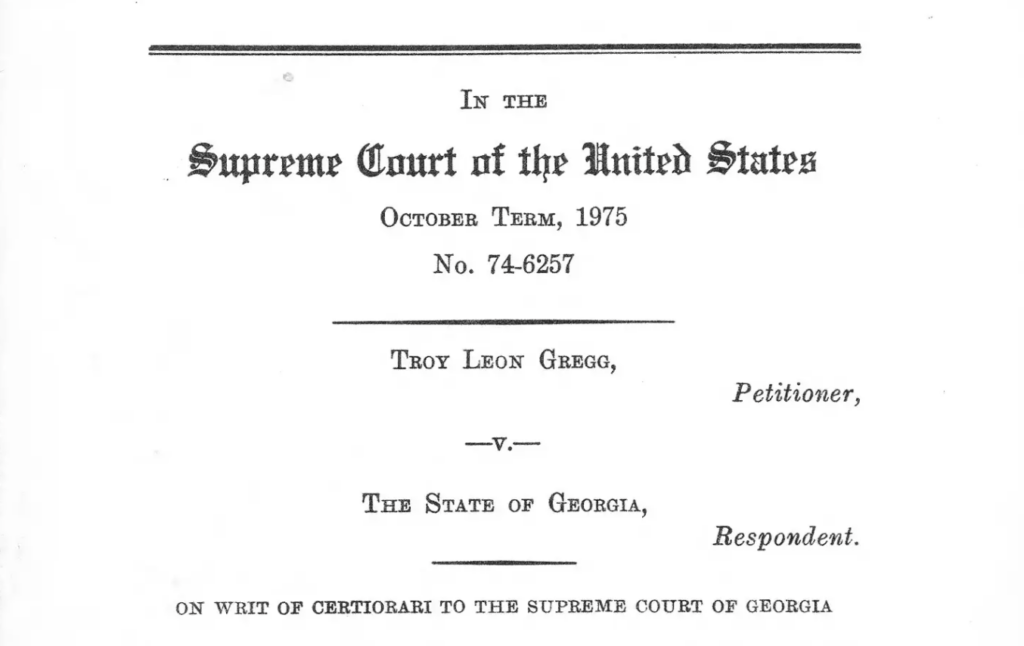
In the 1972 case Furman v. Georgia, the Supreme Court ruled the death penalty unconstitutional, violating the Eighth Amendment prohibiting cruel and unusual punishment due to the death penalty’s arbitrary and discriminatory application. This ruling halted executions until 1976, when in Gregg v. Georgia, the Court sanctioned the death penalty so long as states established laws to prevent the discriminatory application of death penalty sentences.
July 2, 2026 marks the 50th anniversary of the Gregg v. Georgia ruling. At the time of the Gregg decision, those who supported the revival of the death penalty argued that new legal safeguards would create a fairer, more reliable, and less arbitrary system of capital punishment. Examining the legacy of this decision in North Carolina reveals how little the institution of the death penalty has changed this past half-century despite the rapidity with which American society is evolving. “The racial disparities, the arbitrary outcomes, the endless waiting and the risk of executing the innocent,” the exact things which led the court to halt executions in 1972, still persist today (Marshall Project).
This is not, however, indicative of the system failing–the system is operating exactly as intended. And therein lies the problem. Gregg not only reinforced racist and discriminatory practices that established the death penalty in the US, but it legally sanctioned these practices so long as they were thinly disguised under a veil of neutrality. North Carolina’s experience in the wake of Gregg shows the weaknesses and contradictions present in North Carolina’s death penalty system.
Not only does racial bias still pervade North Carolina’s death penalty sentencing, but the economic burden of capital trials and location-based disparities in sentencing have contributed to a 20-year moratorium, or temporary suspension, of carrying out executions. The recent passing of NC House Bill 307 and the impending resumption of executions in North Carolina threatens the rights of those living on death row and has wide-ranging impacts across the state.
Gregg’s Promise vs. North Carolina’s Reality
The racial bias that Gregg claimed to eliminate is still present in North Carolina today. North Carolina’s death row is 50.4% black (50 men and one woman out of 123 total people sentenced to death), despite black people only making up 20% of North Carolina’s population as of 2024 (Death Row Roster, Census). The causes of this disproportionate death row representation are varied, but biased jury selection processes and sentencing disparities based on the victim’s race play a significant role in shaping NC’s death row population.
In all capital trials between 2008 and 2019 in NC’s Wake County, the ACLU found that prosecutors excluded 43% of eligible black jurors using death-qualification exclusions and peremptory strikes. Peremptory strikes are allowed so long as removals are not race-based, but it has been common practice to skirt this since the passing of Batson v. Kentucky, a landmark case decided in 1986 ruling it illegal to strike jurors based on their race. Pamphlets like BATSON Justifications: Articulating Juror Negatives, among other training materials provided to new prosecutors, offer race-neutral explanations for striking non-white jurors. These jury selection practices illegally skew jury populations, often leading to all- or almost all-white juries trying the cases of non-white defendants.
Further, the race of the victim often plays a much larger role in the sentencing process than the race of the perpetrator. Past studies have shown that defendants facing a death sentence were three times more likely to be convicted if their victim was white than if the victim was black. More recent national studies have shown the impacts of race on death sentencing, going beyond only the race of the victim, but also the races of the defendants, jurors, and prosecutors. This database compiles national racial demographics of people sentenced to death and their victims starting in 1972, often referred to as the modern death penalty era (marked by the passing of Gregg). The arbitrary nature of death penalty sentencing is apparent when looking at the weight the race of the victim holds in making that decision.
The Costs of Capital Punishment
The economic burden of the death penalty is primarily borne by taxpayers. Put simply, the death penalty is expensive. Trial costs, the appeals process, incarceration needs to support death row, and the executions of imprisoned people add up to an additional $700,000 for taxpayers on average nationally (2017 Oklahoma Study). A 2009 study, however, shows that in North Carolina, the death penalty costs taxpayers $11 million annually. While this study was conducted over a decade ago, it does not reflect current costs of maintaining death row and taking care of those sentenced to death. If executions resume, though, it would be reasonable to assume taxpayer costs would at minimum begin around $11 million, but likely rise. Additionally, in North Carolina alone, there is a $2.16 million average additional cost for each case resulting in execution as opposed to life in prison. Taxpayer money spent on maintaining the death penalty could be diverted towards other public goods and services like education, healthcare, or other community infrastructure projects.
In addition, geographic disparities in seeking the death penalty perpetuate arbitrary patterns of sentencing, directly violating what Gregg claimed to eliminate. In North Carolina, some county district attorneys voiced explicit opposition to the death penalty while running for district attorney–Chatham, Orange, and Durham counties’ D.A.’s among them. Other counties, like Wake, Forsyth, and Cumberland, have elected D.A.’s with strong histories of pursuing the death penalty. Click here to view an interactive map containing data on death penalty sentencing in each of NC’s 100 counties.
Those sentenced to death in the 1990s faced a different legal landscape than people today, with no surety of defense competency and lacking the right to see all evidence in their case files (Invalid Sentences). Many of the sentences handed down decades ago would be considered invalid by today’s standards due to the passing of legislation like the Racial Justice Act and changing public attitudes, among other death penalty reforms.
North Carolina’s current 20-year moratorium on executions is in place primarily due to appeals overwhelming the system after the passing of the Racial Justice Act in 2009, allowing those sentenced to death the opportunity to commute their sentences if they could prove racial discrimination during the jury-selection processes of their trials. The constitutionally-mandated appeals process is lengthy and costly, both of which House Bill 307 was crafted to subvert. House Bill 307 limits the window to begin the appeals process in capital cases, “requiring any filing more than 24 months old to be scheduled for a hearing by December 2026, and no later than December 2027” (DPIC). This shortens the amount of time currently convicted people spend on death row, thereby reducing the cost of taking care of those sentenced to death as they work through the appeals process. A shortened appeals window increases the likelihood of executions being followed through, with less opportunity for incarcerated people to prove their innocence or to prove any violation of due process in their trials.
Public support for the death penalty has waned to around 50%, and nationally, “fewer than 1 in 6 death sentences result in execution” (DPIC). Further, murder rates have declined since North Carolina’s last execution in August 2006–showing that executions are not necessarily a greater deterrent than life imprisonment. The continued imposition of the death penalty does not benefit North Carolina. It is time to let go of Gregg and begin a new legacy, starting with turning away from the death penalty.